

Kid Processing Units
“The acquisition of basic computing skills by any set of children can be achieved through incidental learning provided the learners are given access to a suitable computing facility, with entertaining and motivating content and some minimal (human) guidance.”
Teach a Child to Fish....
Not every child will grow up to write a best selling novel, or paint a masterpiece, or deduce the unifying theoretical framework of physics, but every child can have a chance to discover or even master something new to them, just as inventors and artists of the past did for the very first time.
We all start with addition and subtraction before moving on to geometry and algebra. So why shouldn't kids be able to learn from the same basic building blocks from which Bill Gates and Steve Jobs started their careers?
I've been watching the ongoing "One Laptop Per Child" initiative for developing-world children with some disappointment. Instead of a magic plastic box or smartphone app, at least a "tinkerer adept" minority of kids could really use a more basic system to learn rudimentary computer concepts....on a machine that is so inexpensive that even third-world parents on $2/day aren’t tempted sell it for a month’s worth of food.
Certainly flashy and cartoonish educational software on full color displays may provide a convenient digital whiteboard to teach math and language. However, in this age of educational computer programs, we experience myriad instances of cashiers who cannot make change without the register doing the math, or adults posting on Twitter who are unable to coherently assemble a complete thought. Children who learn to write with crayons, paint with watercolors or play with Lego building blocks grow into writers, painters, mechanics and engineers who readily adapt their skills to the use of devices and software For a free and fair technological society to flourish, it is critical that kids of all levels have a chance to learn to identify, if not completely master what's under the hood in the structure of computers.
Below is an excerpt from a 2014 email exchange with Lee Hart, developer of classic “retro-computer” kits with the same architecture as the early microcomputers that Steve Wozniak and Paul Allen would have loved to have had as a child:
...I well remember the excitement and magic of building and programming my very own computer. That magic is pretty much lost in today's clever little "appliance computers".
There is a quote I like by Geoffrey Orsak, the dean of engineering at Southern Methodist University: "All children are natural born engineers. Watch them at play. They're not just playing; they're building, learning, experimenting, and creating. They are engineering! Then we put them in school and spend years squashing it out of them."
I think he has it exactly right. We pretend we want students to learn science and engineering, but then teach it in a rigid formulaic way by rote memorization. That sort of education is fine for mechanistic muscle-skills; but useless for learning to think.
The early computers were "thought amplifiers". They encouraged (even required!) you to think and learn and invent. But today, while computers are wonderfully powerful, it is essentially impossible to build or modify them, or to program them yourself for even the simplest things. Everything depends on hardware that someone else built, and software that someone else wrote for you. How it works is all "magic".
--
Obsolete (Ob-so-LETE). Adjective. 1. Something that is simple, reliable, straightforward, readily available, easy to use, and affordable. 2. Not what the salesman wants you to buy.
Purpose
Introduce kids to internal computer architecture in a fun way. This is not about how to operate particular computers (Apple, Microsoft..) or program in specific languages (C++, Python) ....rather, to teach about HOW things are going on inside ALL computers with ALL languages, and do it in a very active, engaging way.
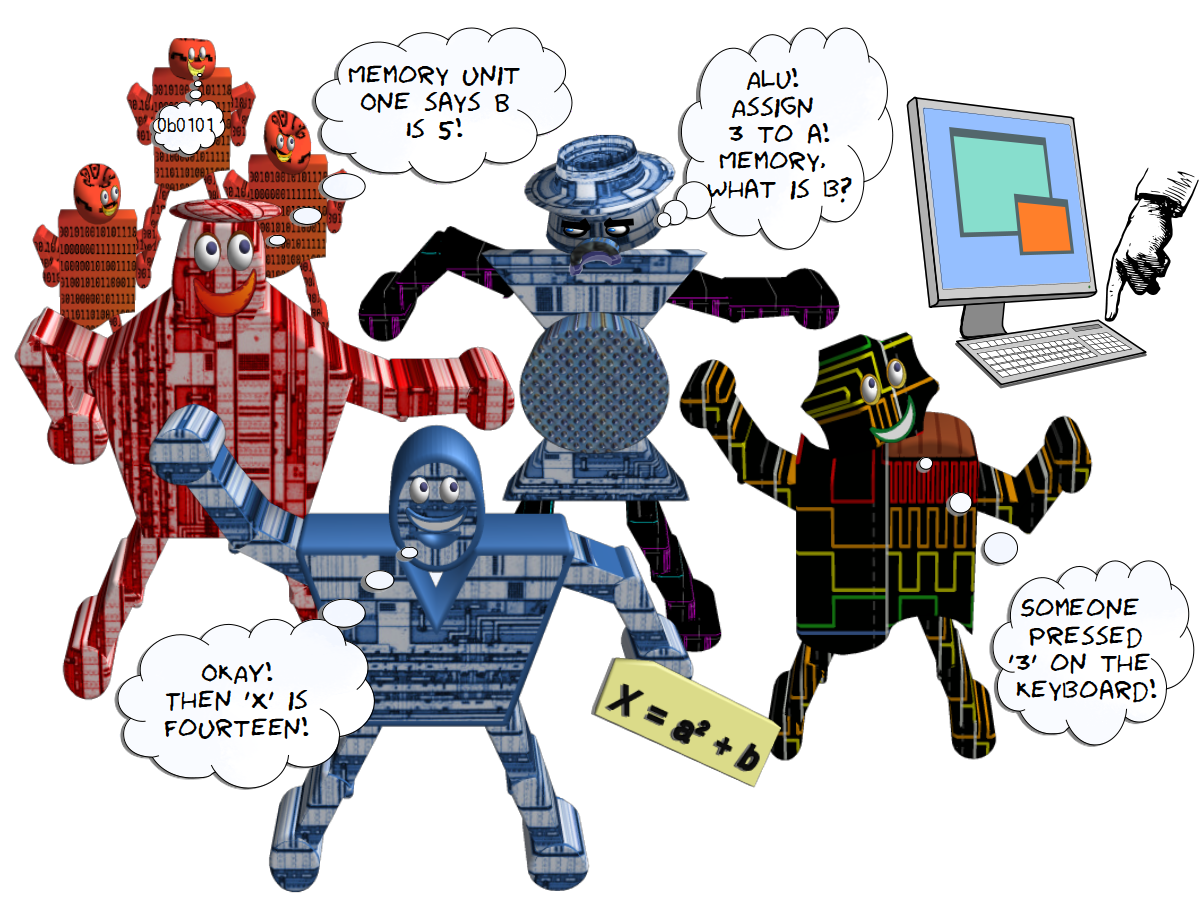
We start with a basic introduction to the CPU: Central Processing Unit. But instead...it is a KID PROCESSING UNIT--KPU--where the kids are the circuits.
What we do is explain the function of each block of a basic Von Neumann computer architecture, and then assign a kid or group of kids to perform the task of each of those blocks. These blocks are VERY basic, and the task obviously SIMPLE. The complexity occurs when the "System" starts running and all the blocks (kids) interact.
This can turn into a wild activity, because the kids won't know the OUTPUT of the system until the PROGRAM is completed.